Just published – the first DI Biddie O’Sullivan mystery

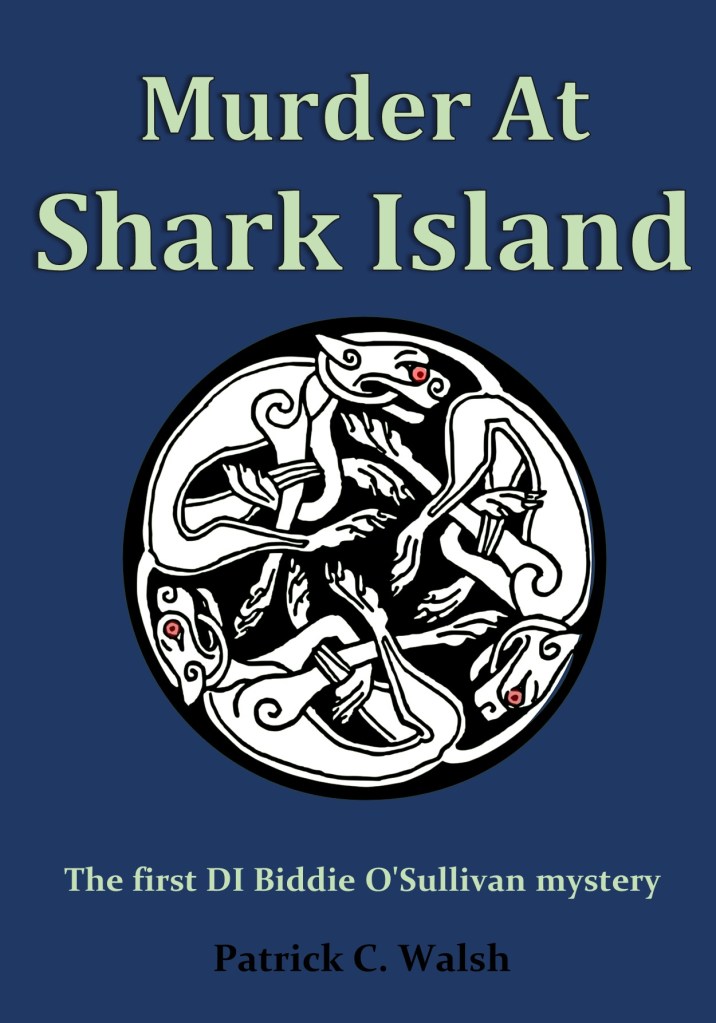
You can now find my latest crime novel, Murder At Shark Island, on Amazon books. This has been something of a new departure for me as so far all of my crime novels have featured retired murder specialist Mac Maguire. It would be fair to say that Biddie is a little different.

She’s a Garda detective working out of Cork City, Ireland. She’s also six foot three inches tall and a black belt in Tae Kwon Do. She is currently unattached but wishes that she wasn’t. Her son has just moved out and is enjoying his university life while she is rattling around an empty house. Work becomes everything to her and, in this her first case, she gets the job no-one wanted…

Continue reading

Don’t rush to publish – create a process and stick to it

This is some advice that I wished had been given to me when I was publishing my first book The Body in the Boot. The big problem was that, now that I had a completed book burning a hole in my hand, I desperately wanted to get it out there as quickly as possible. And so I did. However, since that time, I have had to re-edit and republish the book several times in order to get it anywhere near to a reasonable standard. However, I was lucky in that most of my readers forgave me for the typos, poor editing and formatting saying that they liked the story. However, more than a few also pointed out its shortcomings which, although it stung a little at the time, in the end proved to be immensely helpful.

Continue reading

My new detective – Biddie O’Sullivan

As a writer, I try to make plans but I’ve learned that, sometimes, such plans can very quickly go out of the window. I was halfway through Mac Maguire’s fourteenth adventure, A Murdered Crow, when a new idea hit me pretty much out of the blue. It was all Mac’s fault really as I had him reviewing some crime novels as part of his investigation into a murder and, in order to give him some clues, I had to invent a couple of authors and their fictional detectives. One of these fictional characters was called Detective Inspector Biddie O’Sullivan who works out of Cork City, Ireland. As I say, Biddie was invented just to help Mac’s plot along but, somehow, she stuck in my head.

Continue reading

My Top Ten crime movies

I was recently thinking about how movies have been a constant backdrop in my life and how crime movies, especially film noir, have contributed in leading me into a career in crime writing. There are loads of Top Ten lists around and I began wondering what my Top Ten of crime movies might look like. You can see them below and they are in no particular order.

Please note that I don’t claim that any of these are the best crime movies ever, they are just the ones that I like most.

Continue reading

The recipe for a good murder mystery…

I’ve been reading one of Miguel Barclay’s cook books and I really like the simplicity of his recipes. The book is based on the notion that you can eat well for just one pound ($1.20) a portion but, besides the fact that they taste good and are nutritious, the real appeal for me is that all the meals are quite quick to cook. To explain, I used to love cooking and found it to be something of an antidote to the stress that had built up during a long working day and commute. I didn’t even mind if the recipe was complicated, it just gave me more time to unwind.

That was great when I had the energy or spoons to do it but now I’m finding that, by the time I’ve cooked the meal, I might not have enough energy left to enjoy it. So, Miguel, with his quick recipes, has helped to restore my love of cooking by allowing me to spend less energy in the kitchen thus allowing me to enjoy the eating part too. I was looking at one of his recipes yesterday and I started wondering what would be a good recipe for a crime story. This is my take on that…

Continue reading

Do it yourself book covers – Part 4 – Ebooks and paperbacks

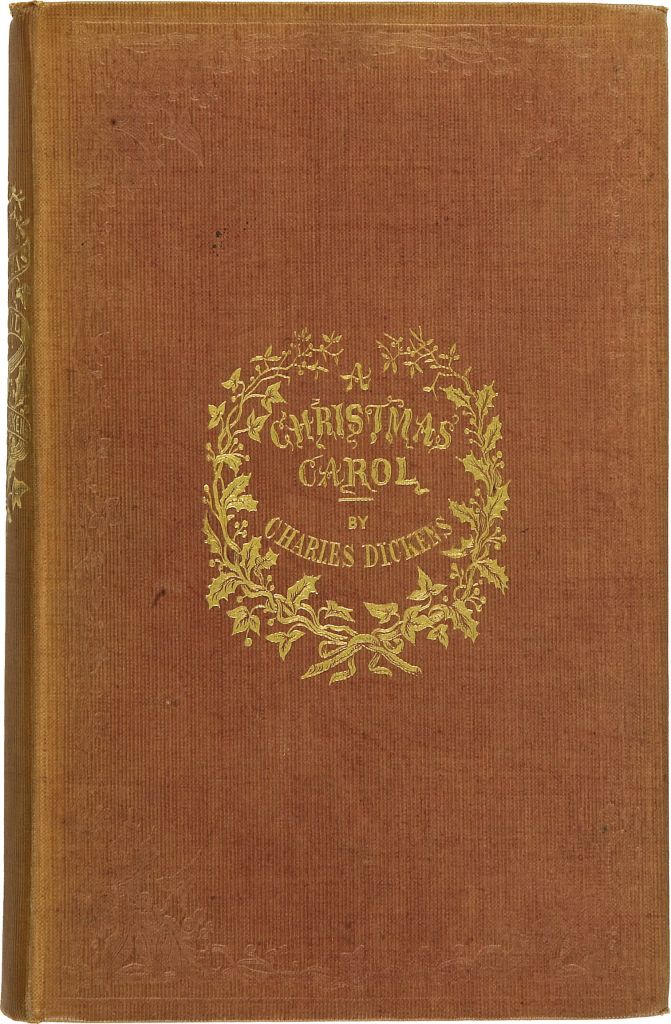
Once upon a time, books were precious objects and meant only for people who could afford them. They were mostly leatherbound and often with tooled gold leaf such as this first edition of Dicken’s classic Christmas novel. Books like these were put on display and were as much a status object as having fine paintings or furniture. Even more, perhaps, as it implied that their owners were of a sensitive and literate disposition.

Although a sort of dust jacket was in use as early as the 1820’s, it was a century later that they became ubiquitous. Publishers also found it cheaper to produce ornate dust jackets than ornate tooling and binding and so the book cover was born. Now, books became a display item in shops and visual information about the book was immediately available to a purchaser.

Paperbacks were being produced in the 1840’s in Germany so they are hardly a new idea. However, they took off in the 1940’s with Allan Lane’s Penguin books. These tended to be mostly reprints of existing titles but in the 1950’s the paperback revolution really kicked off with original titles being published en masse for the first time. These were books that just about everyone could afford and original genre fiction such as romance, science fiction, westerns and, of course, crime became wildly popular.

Continue reading

Do it yourself book covers – Part 3 – Using images

herat is a lonely hunter cover

While there are some book covers that don’t use images like the one on the left, I’d guess that these are in the minority. However, in this case, the stylised 3D font used in the title is a sort of image anyway. So, the first question you might want to ask is, does my book cover actually need an image? If the answer is yes then read on.

If you search in Amazon books for a particular genre and scroll down the covers then you will see that the huge majority of book covers use an image. If the search is for crime novels then you will also see that many of the covers are quite similar; dark colours with a solitary figure usually in silhouette. Of course, the plus point of this is that this is useful visual shorthand for telling the reader what genre they’re looking at. While I’ve read that putting a human figure on a cover sells books, I’ve never actually found any hard evidence to support this. There’s a lot of information out there about what makes the best cover and a lot of it is quite contradictory. So what’s the best course to take?

I’ve honestly got no idea. Anything I say in these posts is just my take but, for me, my covers are an integral part of the book. While I obviously want people to read my books, none of them have been written with commercial considerations in mind. I’ve just tried to write the stories that come to me as best I can. I feel the same about my covers. I don’t want a gloomy cover with a solitary figure unless that’s what I feel the story needs. If you look at my covers, you can see that they’re all quite different but, hopefully, they all reflect something of the story inside. I’ll use three examples to illustrate this.

Continue reading

Do it yourself book covers – Part Two – How to compile your cover

You might wonder at the word ‘compile’ being used in this context. After all, it means ‘ to collect information in order to produce a list or a book‘ or, indeed, a crossword. However, I think that it’s quite appropriate as every book cover can be viewed as something of a puzzle.

Firstly, I’d like to demystify the art of producing book covers a little. Many writers think that this involves some dark technical arts and skill sets that they could never achieve. They are wrong on both counts. When I worked at the BBC, I was for the most part embedded in web design teams. These teams would be self-contained and have all the skills required to produce a state of the art website, in this case BBC Sounds. The team was comprised of coders and designers but also others who looked at the structure of the website and who were responsible for turning audience data into better websites.

The designers I worked with fascinated me. For all the high tech available, they most often selected the simplest techniques to get where they wanted to go. Pencil sketches and sticky notes for the most part and only towards the end, when the designs needed to be formalised, did they start using software. Even then, it would sometimes be relatively simple software. I learned that not all designers are experts at Photo Shop and the like.

Continue reading

Do it yourself book covers – Part One – Introduction

When I published my first book, I was lucky in that I knew someone who was a talented graphic designer. I gave him a brief and he came back to me with some wonderful images. This worked fine until the designer was no longer available and I was faced with a dilemma. Get a new designer or do it myself. I opted for the latter.

You might think that this was a bit presumptuous of me, after all I’m a writer not a designer. However, I had worked at the BBC for nearly fifteen years with some of the best designers around and a fair bit of it was bound to rub off on me. So, every cover since book nine – The Tiger’s Back – has been done by me. It’s not up to me to judge my own work but I get my readers, who sanity check my books before publication, to also comment on the covers. So far, so good.

But it’s a lot of work and what do I really get out of it?

Continue reading

What the new year might bring for Mac Maguire and me…

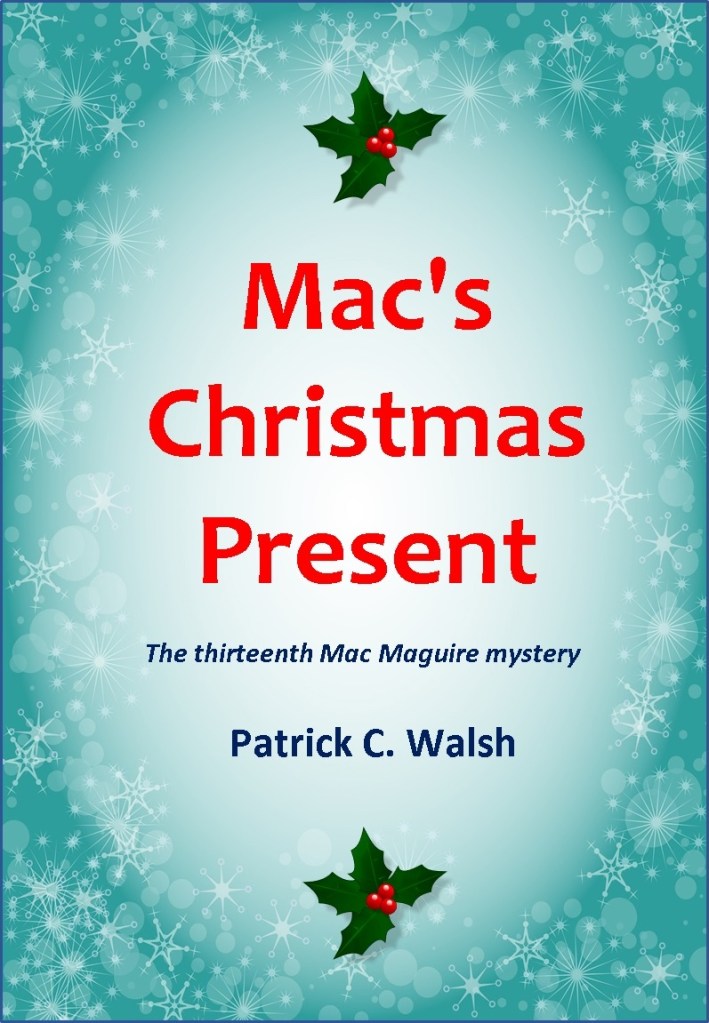
I had high hopes for last year but it turned out to be quite a frustrating time for me. In the end, I did get a novel published but only just. Mac’s Christmas Present was published last December and, somewhat to my surprise, seems to be doing quite well. However, while I am outlining some goals that I hope to achieve this year, I am always aware of the many life events that can blow one off course. Anyway, here goes.

I would like to write yet another Mac Maguire mystery set at Christmas this year. Mac’s Christmas Present is around forty thousand words which is somewhat shorter than my other novels. That’s the reason that I set the price so low (currently $1.19 in the USA and £0.99 in the UK). I plan to keep the price low throughout this year. However, it would be nice if I could write a companion piece set at Christmas one year later on. This should bring the word count up to eighty thousand words or so and more in line with my other books.

Continue reading