I was recently thinking about how movies have been a constant backdrop in my life and how crime movies, especially film noir, have contributed in leading me into a career in crime writing. There are loads of Top Ten lists around and I began wondering what my Top Ten of crime movies might look like. You can see them below and they are in no particular order.
Please note that I don’t claim that any of these are the best crime movies ever, they are just the ones that I like most.
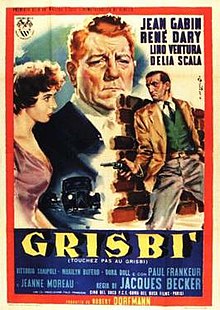
Touchez Pas Au Grisbi (Don’t Touch the Loot) is a 1954 French film noir starring the great Jean Gabin. He gives a beautifully nuanced performance as, Max, the ageing master thief who has just pulled off a major heist, eight gold bars stolen from an airport. He is planning to retire but a rival gang have a different idea. They kidnap his sidekick to see if they can find out where the gold is being kept by torturing him. Max could just walk away with the gold but he finds that he cannot and so a cycle of violence begins as Max tries to rescue his friend.
This is a true film noir as every shot seems to be at night and the shadowy Parisian underworld has never been better portrayed. It was filmed in black and white but it is the greyscale of a man’s personal morality that held me throughout. A genuine film classic.
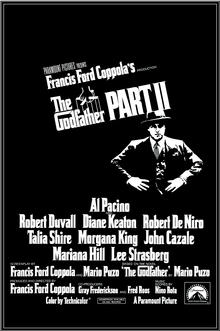
The Godfather Part 2 would, I think, be on most people’s lists. The first in the series was seriously good but this movie tells two stories and both are brilliantly told. The first shows how Don Vito Corleone became the head of a mafia family with a searing performance from Robert De Niro. I would rate it as one of the best in any crime movie. The second details his son Michael’s descent into evil, another great performance from Al Pacino. In the first Godfather movie, Michael can be seen as being more human but, by the end of the second, he has become an unfeeling monster.
The tragedy is that, in my view, Don Vito wanted something better for his youngest son but, due to the assassination of his older brother, Sonny, Michael is forced into taking over the family business and it ruins him as a human being. While his father managed to keep at least some of his humanity, Michael totally loses his when he arranges for his own brother, Fredo, to be killed.
A quite stunning and relentless piece of filmmaking.
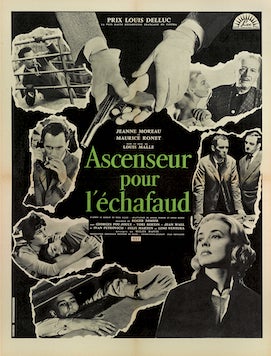
Ascenseur pour l’échafaud (Lift to the Scaffold) is a 1958 film by the French/American auteur Louis Malle. I first saw this on a late night slot on the TV in the sixties. It is a movie about two ill-starred lovers who decide to murder the woman’s husband so they can be together. It’s a story that has been told many times in other great movies such as Double Indemnity and The Postman Always Rings Twice but this movie, apart from the great twists and turns in the story, has two great things going for it – the streets of Paris by night, especially the scene where Jeanne Moreau walks down the Champs Elysees, and the soundtrack. This was improvised by one of the true greats in music, Miles Davis. We might guess that the two lovers are doomed by the music alone as Davis brings an air of world-weary sadness that portends the ending. In my opinion, one of the two greatest soundtracks to a crime movie ever.
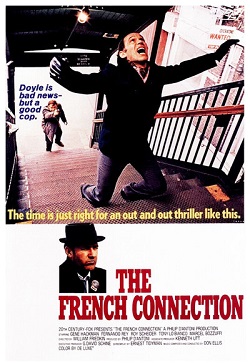
The French Connection is a movie that I’ve seen over and over and I’ve enjoyed it more with every viewing. It has a great story, great locations and stars one of my favourite actors, Gene Hackman. It also has what I still regard as one of the great car chases of all time.
Unbelievably the director, William Friedkin, didn’t like Hackman for the role of ‘Popeye’ Doyle and went after several other actors (including Rod Taylor!) but, thankfully, he settled on Hackman at the end.
It’s an all-action movie that might seem a little cliched now but that’s only because so many other directors have drawn inspiration from it. Admirers of the film include Kurosawa, Spielberg, Fincher and, of course, me.
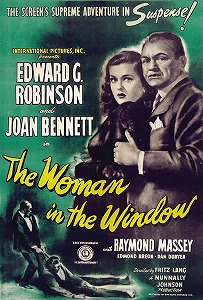
The Woman in the Window is a 1944 movie that stars Edward G. Robinson but here he is playing somewhat out of character. Rather than his usual gangster roles (Little Caesar, Johnny Rocco etc.) he plays a college professor who becomes entranced by the painting of a woman on display in a gallery window near his club. When the woman’s face appears alongside the painting, he turns and finds that it is indeed the same woman. She turns out to be a femme fatale and is wonderfully played by Joan Bennett.
After joining her for drinks at her home, they are interrupted by the arrival of Bennett’s rich, and very jealous, lover. A fight occurs and Robinson kills the lover in self-defence. And so the nightmare begins.
This was directed by the great Fritz Lang (Metropolis, M, Fury, Clash by Night etc) and is heart-stoppingly suspenseful. I won’t be a spoilsport though and talk about the ending. If you haven’t seen it yet then you should.
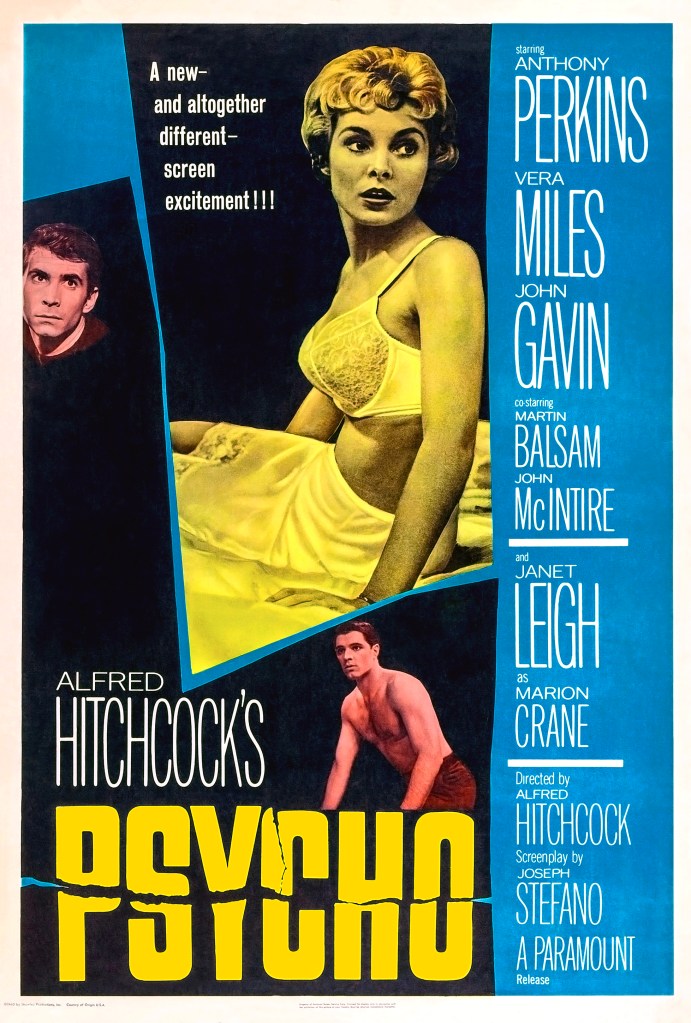
Psycho, despite its many imitators, is a one of a kind movie. It was directed by the master of suspense, Alfred Hitchcock, and released in 1960. I first saw this around five years later in a cinema in Birmingham. It had quite a reputation as a scary movie and, even though I was technically too young, I snuck into the packed cinema and hid myself in the darkness.
The film, though, was even darker.
Many credit it with making the ‘jump scare’ popular and, while it does indeed have at least three moments that make you jump out of your skin, there is so much more to it than that. It also has the most wonderful score by Bernard Herrmann and the music adds so much to the story (who can ever forget the shrieking violins in the shower scene?). A wonderfully photographed and crafted movie, it left me with a sense of being chilled to the bone in that I felt that I had just had a peek into the mind of a serial killer. I realised then that people like Norman Bates actually existed and walked amongst us. Perhaps he was sitting next to me in that very cinema.
That was the most chilling thing of all.
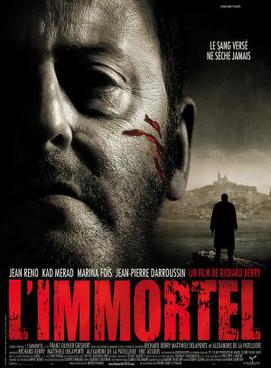
L’Immortel (22 Bullets) is a 2010 French gangster movie starring the great Jean Reno. Here Reno, plays a retired gangster who is ambushed and shot 22 times. Incredibly, he survives the assassination attempt. This would be far-fetched indeed if it wasn’t actually based on fact.
A real-life gangster called Jacky Imbert was shot 22 times and lived to tell the tale. Here Reno’s character seeks revenge and gets it, going after the would-be assassins one by one.
I remember this film as one that grabbed you by the scruff of your neck and dragged you along as the story unfolded. A great film with a central role that is wonderfully played by Reno. Worth noting that another film starring Reno, Leon: The Professional, nearly made it onto the list as well.
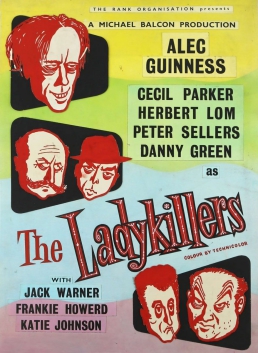
The Ladykillers Well, I had to include a comedy crime caper and this is without any doubt one of the best ever. Released in 1951, it has an all-star cast including Alec Guinness, Peter Sellers, Herbert Lom, Cecil Parker and with cameos from some of the great British stars of comedy at the time.
In the film, a sweet old lady rents rooms to the sinister ‘Professor’ Marcus (Alec Guinness) who tells her that he wants to use the room as a rehearsal space for an amateur string quintet. In reality, they are a gang of hardened criminals who are planning the sophisticated robbery of a security van. While they succeed in stealing the money, everything afterwards goes hilariously wrong.
The sweet old lady finds them out and so they plan to kill her. However, after blunders and double crossing the gang only end up killing each other. Great performances all round especially from Katie Johnson as the sweet old lady.
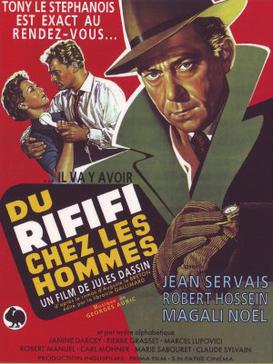
Rififi is a 1955 movie directed by the then Hollywood blacklisted director Jules Dassin. It is the greatest of all the heist movies and the robbery itself, over thirty minutes long and filmed in almost total silence, is a masterpiece. I first watched this when I was only seven or eight and, while I didn’t understand everything that was going on, I remember that the suspense was intense. Watching it later as an adult, I felt sorry for the main character as, while the robbery itself works out, the aftermath brings him nothing but tragedy.
You could argue that, while heist movies existed before Rififi, this movie took it to a new level. An unarguably classic crime movie.
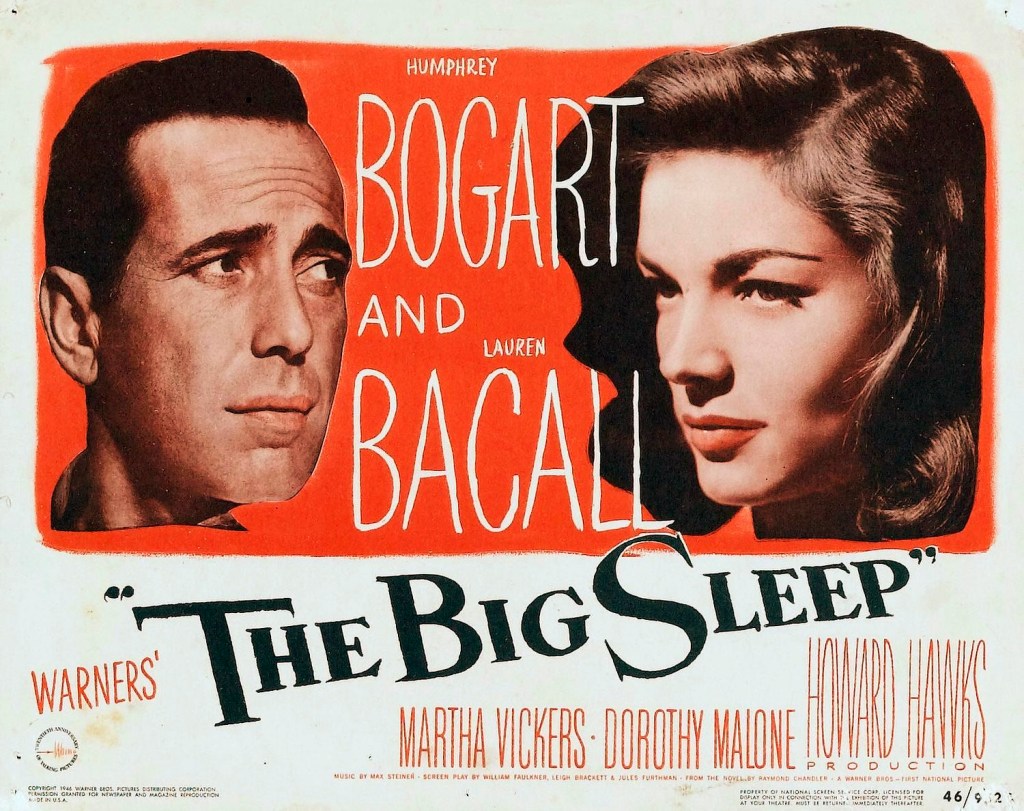
The Big Sleep, for me, is the very essence of film noir. Filmed in 1946 by Howard Hawks, this movie has everything. Two great leads, Bogart and Bacall, with an amazing chemistry (they later married), a great director, great writers (including William Faulkner) and it was based on a terrific novel by Raymond Chandler. Bogart, of course, plays the role of Philip Marlowe, one of the greatest fictional detectives, and he does the role justice.
This choice also represents other great classic crime movies such as Key Largo, The Glass Key, The Maltese Falcon, The Asphalt Jungle and so on but, for me, The Big Sleep beats them all. I’ve watched this film umpteen times and it’s always like new. Bogart is smart and world weary, Bacall is smart and dangerous. The plot is convoluted and really makes you think. For me this is the best of the best.
Mind you, I’d still like to know who killed the chauffeur…
So, there you have it. There were certainly more French movies in the list than I would have anticipated but I suppose that I shouldn’t have been that surprised. After all they coined the name for the genre and they certainly took film noir to their hearts.
If you haven’t already seen the movies in my list, I’d strongly recommend viewing them at the earliest opportunity. I certainly wouldn’t have become a crime writer without them.
 Patrick C. Walsh Author