
Writing about what you know is probably good advice for any writer. However, if you’re writing a series, sooner or later you are going to have to try something new. This happened to me by book six, Two Dogs. Part of this book, by necessity, had to be set in Paris so I was somewhat taken out of my comfort zone. In subsequent books, The Chancer and The Eight Bench Walk, I take the reader to the North-West of Ireland and then to Cyprus. I can’t say how well I’ve achieved this, as only the reader can judge that, but I’ve certainly had no adverse reviews as yet regarding the locations of my books.
Getting facts about a location wrong can seriously annoy your readers so let’s see what resources you can use to ensure that this doesn’t happen.
Google Maps and Streetview – If there was only one resource you could access then this would be it. Google Maps is great for general information about a specific location. For instance, In Two Dogs, once I had confirmed that the police HQ was at the Quai Des Orfevres in Paris, I needed to find a nearby hotel. The map showed me where all the hotels were, in this case just over the bridge on the Left Bank, and so I picked a reasonably starred one. From the map I could access the hotel website and sift through the picture gallery to see what the rooms and other interior scenes were like. Once at the hotel, I switched to Streetview and I was able to make a virtual journey from the hotel to the police HQ and to describe everything along the way including the crossing of the Seine. I could even describe the boats on the river. I think that Streetview is an incredible gift to writers, enabling them to truthfully describe journeys and locations. Not only that but, as you make the journey, you may find interesting things along the way, things that you can find out more about by clicking on the icons. This can add some interesting layering to your descriptions.
Search can provide lots of information. However, be careful as there is a lot of misinformation and just plain lies out there on the internet. Be persistent, validate your sources and use multiple sources where possible for anything factual that you want to put in your book. You will also save yourself some time if you think very hard about your search terms. Make them as concise and relevant as possible and you’ll get much better results.
Ask around to see if a friend has been there. Also a friend of a friend will do. Ask them what their feelings about the location were, what struck them as being different, getting around, what the locals were like etc.
Reviews can also be a powerful source of information from people who have been there and bought the T shirt to prove it. If you need to describe a hotel, bar, shop, public building etc. then go on their websites. As I say above, you can find out a lot just through doing this but accessing sites or pages that feature customer reviews may give you a different viewpoint and detailed information you won’t get unless you go there yourself.
Go there yourself, if possible. I was lucky in being able to do this for The Eight Bench Walk. After visiting Cyprus, I had the notion that I could set a Mac Maguire story there. I already had the book two-thirds written when I was able to stay in Larnaka for three weeks, half of which I spent on research. This not only gave me great confidence in my descriptions of the town but it also gave me some great new ideas.
Only describe what you need to. Remember that you’re writing a novel and not a travel book. Your descriptions shouldn’t get in the way of your story. Like a good seasoning, it should add flavour to your story without overwhelming it.
If in doubt just make it up. However, if you invent a location, ensure that you’re consistent. If you’re a sci-fi or fantasy writer then you can invent whole new worlds but if you’re a crime writer then your book will normally have to exist within a known space and time. Of course, within those constraints you can still make a lot of stuff up, just think of Ed McBain’s Isola and Christie’s St. Mary Mead for example. For the book I’m working on at the moment, while my island exists within a known part of Ireland, everything on it is totally made up. It’s made it easier to structure the narrative but it’s also been lots of fun. If I can complete the book, it will be the first one I have published that contains a map.
Hopefully, this might help you with your locations and perhaps to be a little more adventurous too.
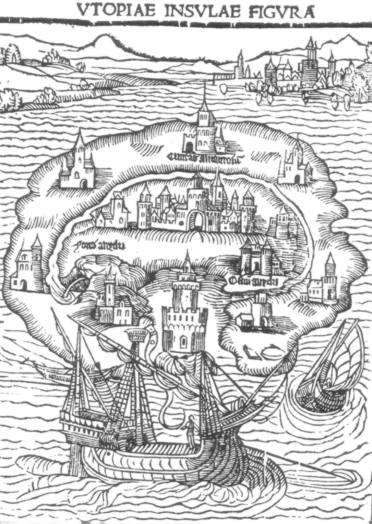
(Thanks to Pierre9x6 for the great photo of Paris and Marcok for the map of Utopia)
 Patrick C. Walsh Author